
Published April 1, 2026
As the school year begins to wind down, many parents are signing their children up for summer camp and other coordinated learning experiences. If your child has severe allergies, you will most likely need to provide the camp staff with an EpiPen (epinephrine) to have in case of emergency. It is important to also make sure the staff know when and how to use it. We heard from a mom who did that last year, while her child was at overnight camp for a week.
The mom sent the child to camp with all their supplies for the week and also provided the staff with a carton containing an EpiPen to store safely in case it was needed for an emergency. She also made sure that the staff knew how to use the EpiPen and was confident they did. At the end of the week, all the unused supplies were sent home with the child, including the carton containing the EpiPen. When the mom was putting the EpiPen away, she opened the carton and found that the pen inside was a training pen and did not contain epinephrine. It turns out, the mom thought the pen inside the carton was an actual EpiPen and not the training device when she provided it to the camp staff. Fortunately, her child did not have an allergic reaction during the week at camp and the EpiPen was not needed.
If you keep an EpiPen (epinephrine) on hand to treat a severe allergic reaction, you need to know about a potentially dangerous mix-up between the actual EpiPen pen and a similar-looking training pen.
EpiPen is an "auto-injector" that looks like a pen but contains the medicine epinephrine and has a needle at one end. When injected immediately for emergency treatment of a severe allergic reaction, epinephrine can be lifesaving. EpiPen Jr contains a lower dose of epinephrine and is used for children. EpiPen and EpiPen Jr are sold in packages with two active pens and one training pen (Figure 1).
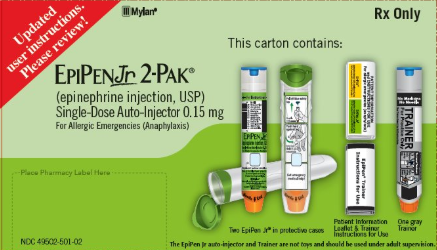
There are generic epinephrine pen devices (Figure 2) available as well. Most epinephrine pen manufacturers package three pen devices in each carton. Two of the pens contain the actual medicine because severe reactions often require two injections, and the third pen is a training pen. The training pen looks similar to the active pen in size, shape, and colors, but it does not contain a needle or medicine. The purpose of the training pen is to allow people and/or caregivers to practice the special method needed to properly administer an injection with the EpiPen: First you remove the blue safety-lock cap. Then you press the orange end of the pen very firmly against the designated area of a leg. That pressure causes the needle to pop out and automatically inject the drug. You must hold the pen in place for approximately 10 seconds, so that the entire dose is injected.

Unfortunately, the training pen and active pens are so similar looking that they are easily confused, even though a label on the training pen states, “TRAINER.” In addition, upon opening the carton, the blue safety release ends are visible (Figure 3) making the three pens look identical which can cause confusion in an emergency.

Mistakenly using the training pen in an emergency would be dangerous. Even without a needle, pressing the training pen hard against the leg may feel the same as an actual injection. Therefore, the person having the allergic reaction could mistakenly think they actually got the epinephrine injection. If the error is not quickly recognized, the person’s symptoms would continue to get worse and could become life-threatening.
Here's what you can do: To prevent mix-ups between the active EpiPen and the training device, follow these recommendations.

.png)